
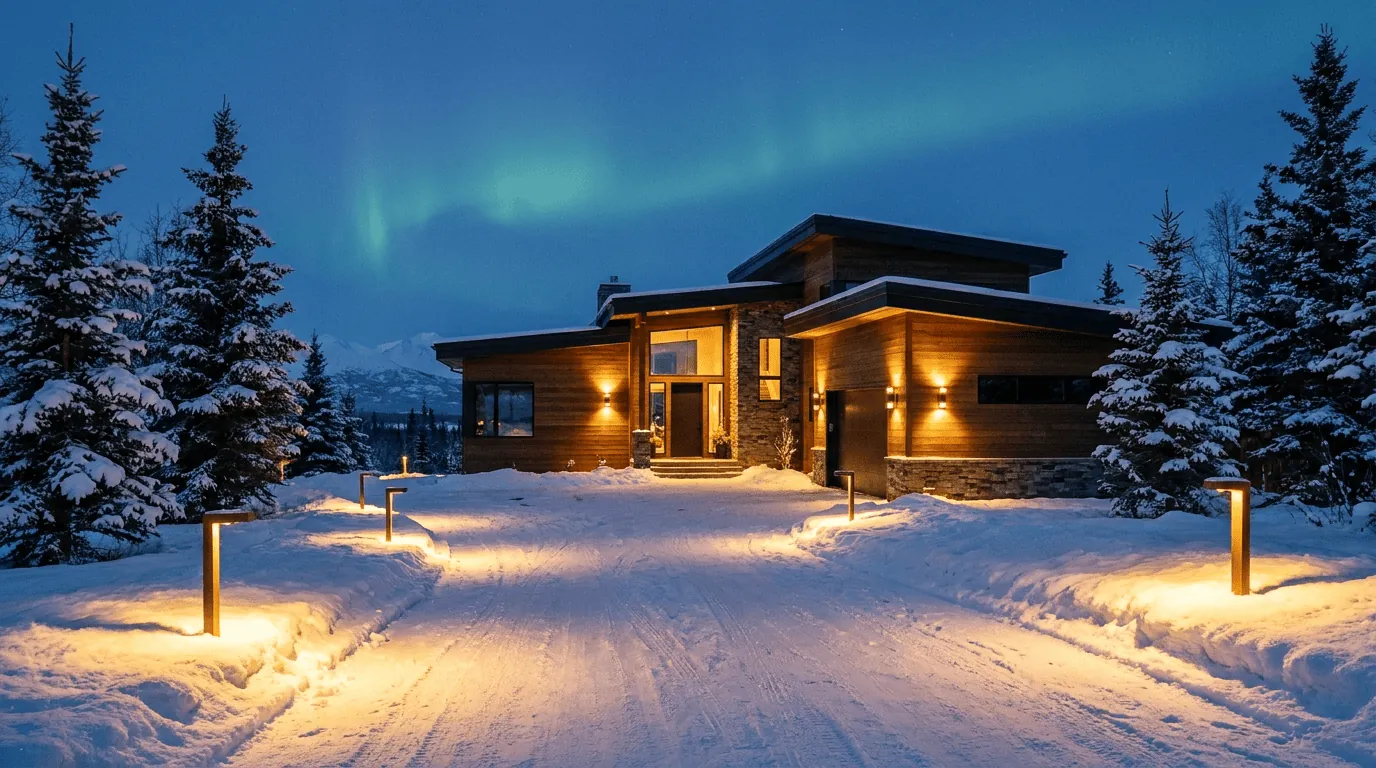
Where lighting makes the biggest difference
- Entries and stairs: icy steps are a winter hazard; even light across treads helps more than a single bright fixture.
- Driveways and parking pads: lighting for snow clearing and for spotting ice — and for wildlife awareness, since moose are common in Anchorage neighborhoods.
- Garages and outbuildings: interior and exterior lighting on separate switching.
- Pathways and decks: low-level fixtures that will not be buried by plowed snow.
View as table
| Month | Daylight |
|---|---|
| Jan | 6 h 42 min |
| Feb | 9 h 24 min |
| Mar | 12 h 06 min |
| Apr | 15 h 12 min |
| May | 17 h 54 min |
| Jun | 19 h 24 min |
| Jul | 18 h 00 min |
| Aug | 15 h 12 min |
| Sep | 12 h 12 min |
| Oct | 9 h 18 min |
| Nov | 6 h 36 min |
| Dec | 5 h 30 min |
Calculated for latitude 61.2° N with the standard sunrise equation (including atmospheric refraction). Values are approximate; NOAA’s solar calculator gives exact times.
Controls: motion, photocells and timers
Motion sensors keep lights off until needed, but snowfall, blowing snow and passing wildlife can trigger them; adjustable sensitivity and zones help. Photocells switch lights at dusk and dawn, which shift dramatically across the Alaska year. Astronomical timers and smart controls can follow those changes automatically. Many homeowners combine a low-level dusk-to-dawn light with motion-activated brighter lighting.
Aim fixtures downward and shield them where possible. It reduces glare for neighbors and drivers, and helps preserve views of the night sky and the aurora.
Choosing equipment for cold and snow
Look for fixtures marked suitable for wet locations where they may be exposed to snow and meltwater, and check the manufacturer’s low-temperature rating. Most modern LED fixtures start well in the cold, unlike some older lamp types. Avoid mounting fixtures where roof avalanches, icicles or plowed snow will hit them.
Exterior outlets and block-heater circuits
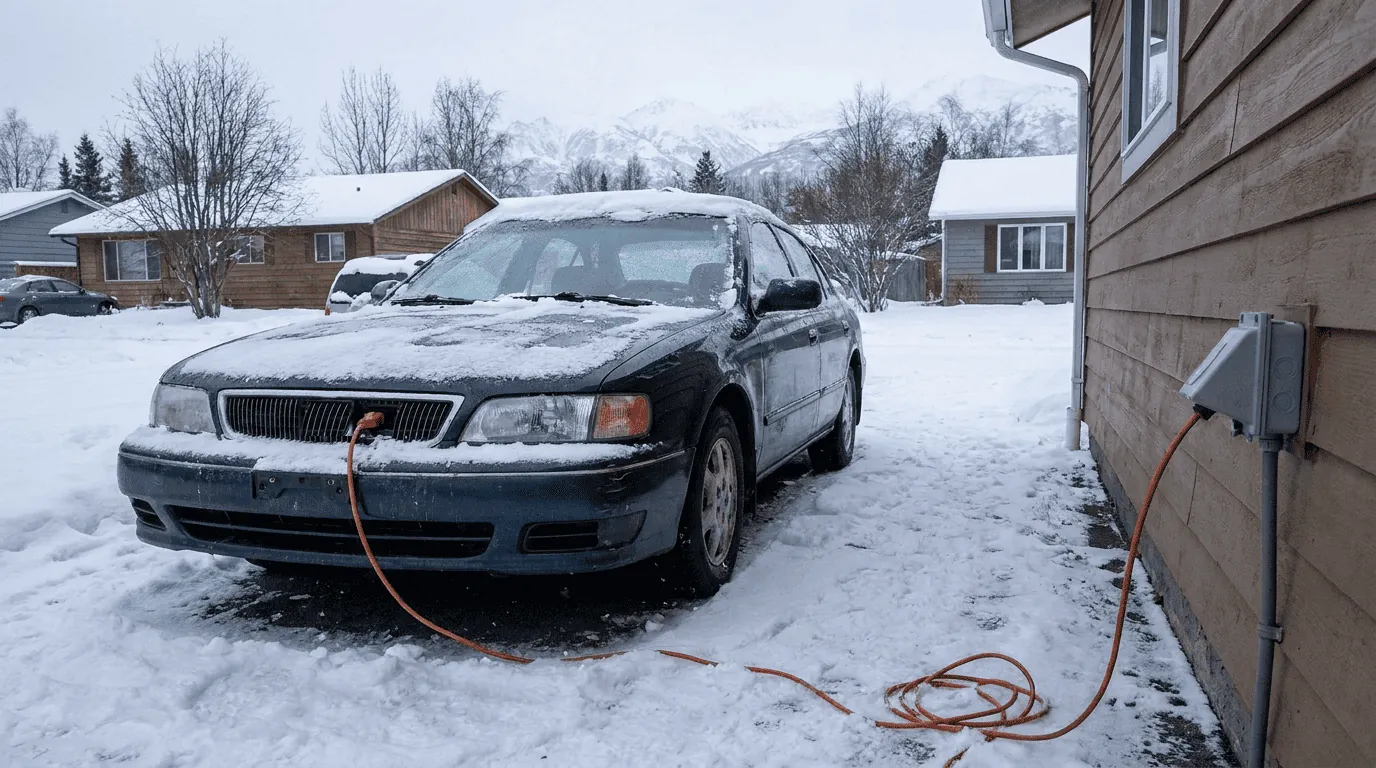
Exterior receptacles are a big part of residential electrical use in Anchorage: engine block heaters, battery tenders, heat tape and holiday lighting all plug in outside. Outdoor receptacles need ground-fault (GFCI) protection and weather-resistant, in-use covers that stay closed with a cord plugged in.
Block heaters commonly draw several hundred to over a thousand watts each. Two vehicles on one exterior circuit — plus holiday lights — can overload it. If an exterior circuit trips frequently or the receptacle is cracked or loose, have it evaluated rather than using heavier cords or adapters.
Safety and permits
Buried cable must be installed at the depth and in the type of conduit or cable the code requires, and anyone digging should call 811 before excavation to have utility lines located. Wiring new exterior fixtures and circuits is typically permitted work.
In the Anchorage Bowl new circuits generally need an electrical permit and inspection under the 2026 code update (2023 NEC with local amendments). Details: Anchorage permits guide.
Questions to ask
- Are these fixtures and controls rated for wet locations and our winter temperatures?
- Can motion sensors be adjusted to reduce false triggers from snow and wildlife?
- Are exterior outlets GFCI-protected with in-use covers?
- How many block-heater outlets can this circuit handle?
- Is trenching or underground wiring involved, and who arranges locates?
Frequently asked questions
How much does outdoor lighting installation cost in Anchorage?
Replacing an existing fixture with a similar one is the smallest job. Costs rise with new circuits, the number of fixtures, wall material, the distance to the panel, and especially trenching for driveway or path lighting, which requires correct burial depth and utility locates before digging. Smart controls, photocells and motion sensors add equipment cost but can reduce running time through long winter nights.
We do not publish prices.
Why does my block-heater outlet keep tripping?
The most common causes are moisture in the receptacle or cord connection, a damaged block-heater element or cord, or too much load on the circuit. Block heaters commonly draw several hundred to over a thousand watts each, so two vehicles plus holiday lights on one exterior circuit can overload it.
Test the vehicle on a different outlet. If the trip follows the vehicle, have the heater or cord checked; if it stays with the outlet, have the receptacle and circuit tested. Adding a dedicated circuit for each parking spot and a timer is a common Anchorage upgrade.
How do I stop motion lights from turning on in snow?
Falling and blowing snow, swaying branches and passing moose can all trigger motion sensors. Choose fixtures with adjustable sensitivity, detection range and zones; aim sensors down toward walkways rather than open yard; and mask the parts of the field of view that face trees or roads.
A common approach is a low-level dusk-to-dawn light for orientation plus brighter motion-activated lighting for entries and driveways. Shielded, downward-aimed fixtures also reduce glare for neighbors and drivers and help preserve views of the night sky.
Are solar-powered lights practical in Anchorage?
They have limited output in December and January, when Anchorage gets only about five and a half hours of daylight around the solstice and panels may be covered by snow. Solar path lights can work as accents in summer, but hardwired fixtures are far more dependable during the darkest months, when lighting matters most for icy steps and driveways.
Sources (4)
- National Weather Service Anchorage — local climate data (opens in a new tab)
- Municipality of Anchorage — press release on the 2026 building code update (AO 2026-33) (opens in a new tab)
- Anchorage Municipal Code Chapter 23.30 — Local Amendments to the National Electrical Code (opens in a new tab)
- NFPA 70, National Electrical Code (free read-only access) (opens in a new tab)