
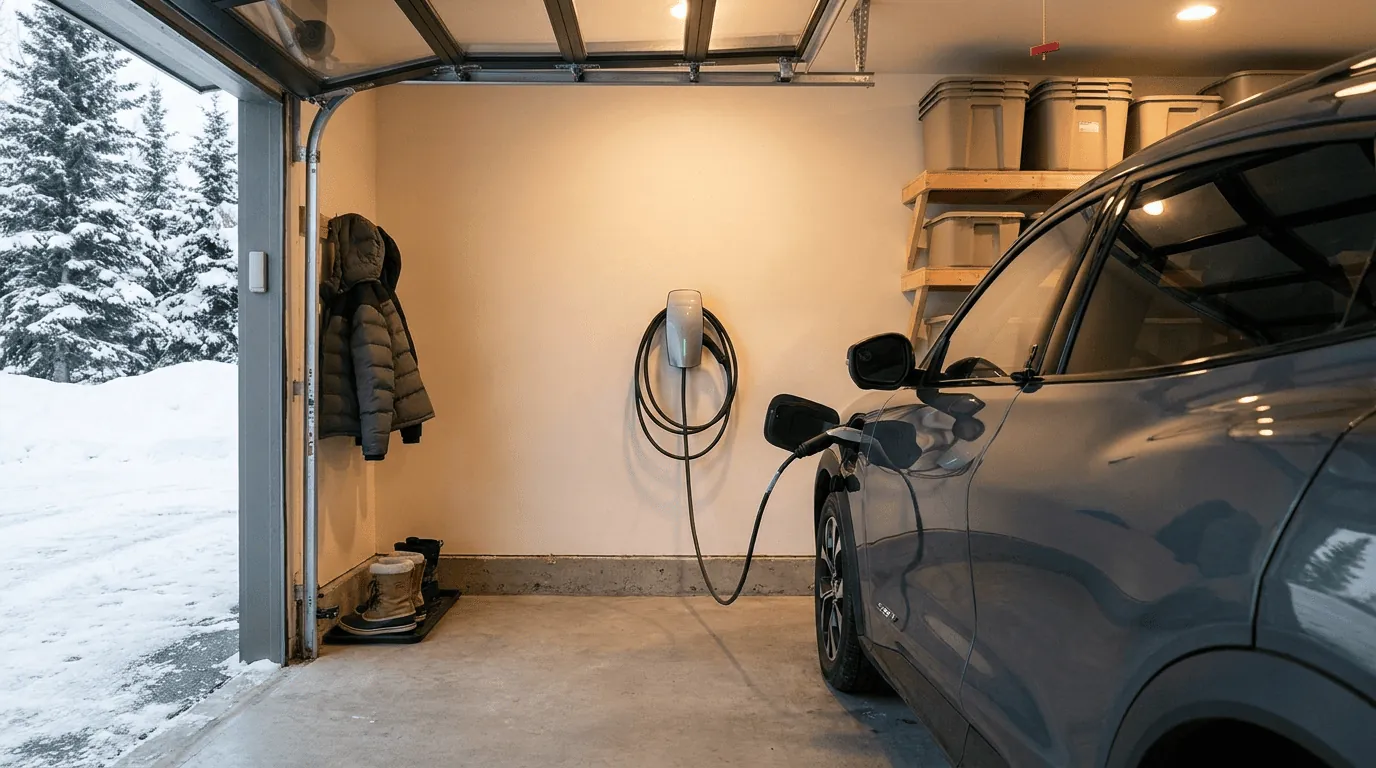
Level 1 vs. Level 2 at home
Level 1 charging uses a standard 120-volt outlet and the cord that comes with many vehicles. It adds range slowly and may not keep up in winter, when cabin and battery heating use more energy. Level 2 charging runs on a 240-volt circuit and is what most owners install for daily use.
| Type | Electrical needs | Notes |
|---|---|---|
| Level 1 (120 V) | Existing outlet (ideally dedicated) | Slow; may not keep pace in cold weather |
| Level 2, plug-in (240 V) | Dedicated circuit to a receptacle | Flexible; receptacle must be suited to the load |
| Level 2, hardwired (240 V) | Dedicated circuit wired directly to charger | Often allows higher output; no receptacle to wear out |
What the installation involves
- Load assessment: checking that your service and panel can support a continuous charging load, usually with a load calculation.
- Dedicated circuit: a 240-volt branch circuit sized to the charger’s rating. Under the NEC, EV charging is treated as a continuous load, so the circuit is sized above the charger’s output current.
- Mounting location: within cord reach of where you park, protected from vehicle impact and snow removal.
- Ground-fault protection: required for many EV charging receptacles and built into listed chargers; your installer should confirm what the adopted code requires.
- Permit and inspection: where required.
If your panel is full or the load calculation is tight, options include a panel or service upgrade, a lower charger setting, or a listed energy-management system that limits charging when other large loads run.
Cold-weather planning
Batteries charge more slowly when cold, and vehicles use energy to warm the battery and cabin. A practical advantage of a garage charger is that you can precondition the car while it is still plugged in, drawing that heating energy from the grid instead of the battery. Chugach Electric has published this tip for members.
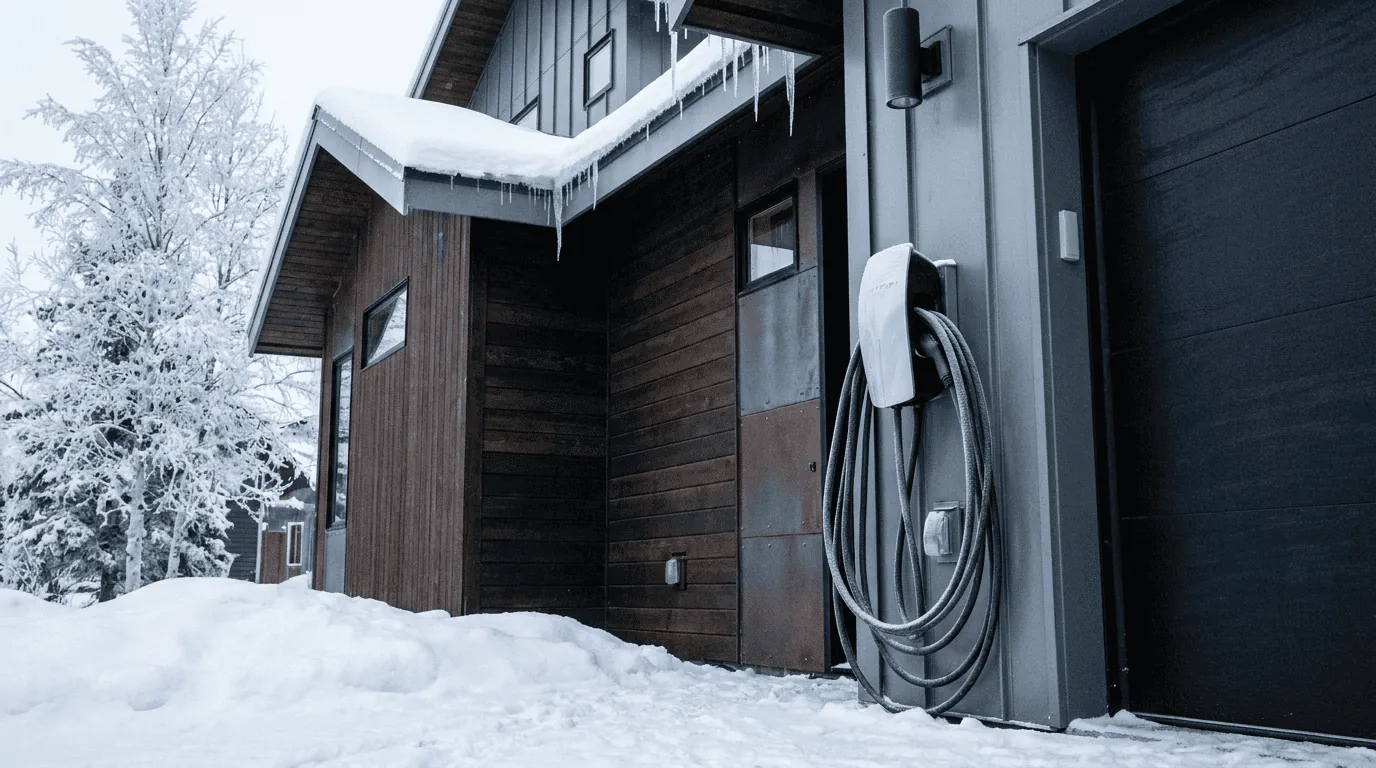
For outdoor installs, choose equipment whose listing and manufacturer specifications cover the temperatures you expect, mount it where plows and shovels will not hit it, and keep cords off the ground where they can freeze into ice. Charging equipment has operating temperature limits; check the specification sheet rather than assuming.
Utility programs and incentives
Chugach Electric has offered EV-related programs to members, mostly focused on public and workplace charging. Program terms change; check directly with your utility (Chugach Electric or Matanuska Electric Association) for anything currently available to residential members. We do not list incentive amounts because they change and we cannot verify current availability.
Permits and manufacturer requirements
In the Anchorage Bowl new circuits generally need an electrical permit and inspection under the 2026 code update (2023 NEC with local amendments). Details: Anchorage permits guide.
Follow the charger manufacturer’s installation instructions exactly — circuit size, breaker type, mounting height and clearances. Installing outside the instructions can void the listing and the warranty.
Questions to ask an installer
- What does the load calculation show for my current service?
- Hardwired or plug-in — and why for my situation?
- What circuit size and charger setting do you recommend?
- Is the charger listed for outdoor use at Anchorage winter temperatures, if mounted outside?
- Will you handle the permit and inspection?
- Can the circuit be sized for a future second EV?
Frequently asked questions
How much does it cost to install a Level 2 charger in Anchorage?
The biggest cost variable is the electrical work, not the charger. A short circuit run from a panel with spare capacity in an attached garage is the simple case. Costs rise with distance to the parking spot, outdoor or detached-garage installations that need trenching or conduit, a full panel that needs a subpanel or load-management device, or a service upgrade when the load calculation shows insufficient capacity. Permits add a modest fee, and specialized components can take longer to ship to Alaska.
Ask for quotes that state the circuit size, charger setting and whether a load calculation was done.
Do I need a permit to install a Level 2 charger in Anchorage?
Installing a new 240-volt circuit is the kind of work that typically requires an electrical permit and inspection within the Municipality of Anchorage’s Building Safety Service Area. The inspector checks circuit sizing, overcurrent protection, ground-fault protection where required, and installation per the charger’s listing and instructions. Plug-in chargers on a new receptacle need a permit for the circuit too.
Ask your installer to obtain the permit. Our permits guide explains which areas municipal permits cover.
Does cold weather affect home charging?
Yes. Lithium-ion batteries accept charge more slowly when cold, and vehicles spend energy heating the battery and cabin, so winter range and charging speed both drop. A garage charger helps: you can precondition the car while it is still plugged in, drawing heating energy from the grid instead of the battery — a tip Chugach Electric has shared with members.
Outdoor chargers must be listed for outdoor use and rated for the temperatures they will see; check the specification sheet. Mount the unit where plows and shovels will not hit it, and use the cable holster so the cord does not freeze into ice on the driveway.
Can I charge my EV from my block-heater outlet?
Not as a regular charging solution. Block-heater outlets are usually ordinary 120-volt circuits, often shared with other loads and exposed to weather. EV charging is a continuous load that can run for many hours, and an old exterior receptacle or shared circuit may overheat. Do not use adapters or extension cords to connect an EV to a block-heater outlet.
If you want 120-volt (Level 1) charging, have an electrician confirm the outlet is on a suitable dedicated circuit with GFCI protection and a weather-resistant receptacle. For daily driving in winter, most owners find Level 2 more practical.
Sources (5)
- Alaska Business — Chugach Electric EV programs (opens in a new tab)
- Municipality of Anchorage — press release on the 2026 building code update (AO 2026-33) (opens in a new tab)
- Anchorage Municipal Code Chapter 23.30 — Local Amendments to the National Electrical Code (opens in a new tab)
- Municipality of Anchorage — Resident utilities (opens in a new tab)
- NFPA 70, National Electrical Code (free read-only access) (opens in a new tab)